Tag: Quality

  • Industrial Silica Sand Price per Ton: How to Compare Two Supplier Quotes Fairly

    Industrial Silica Sand Price per Ton: How to Compare Two Supplier Quotes Fairly

    A purchasing manager receives two quotations for industrial silica sand. The first supplier quotes a price per ton for collection at the supplier’s facility, while the second includes delivery to the factory.

    One quotation appears cheaper than the other. But can these prices be compared directly?

    Not necessarily. The two quotations do not include the same costs and services. Before selecting the most suitable offer, you need to confirm that both silica sand products meet your technical specifications and calculate their costs using the same quantity, currency, and delivery point.

    The quoted silica sand price per ton is the amount a supplier charges under the terms stated in their quotation. The delivered cost per ton is calculated by adding the cost of the silica sand and all necessary expenses to reach the agreed delivery point, then dividing the total by the quantity using the agreed weight basis.

    Understanding this difference helps industrial buyers compare silica sand suppliers more accurately and avoid unexpected procurement costs.

    1. Do Both Silica Sand Quotations Meet Your Technical Specifications?

    Before comparing silica sand prices, confirm that both suppliers are offering material suitable for the same industrial application.

    Two suppliers may quote different prices for silica sand, but variations in particle size distribution or impurity levels can make one product unsuitable for your production process, even if it is cheaper.

    Review the technical information provided in each quotation, particularly the following:

    • Particle size distribution: Does the grain size and its distribution fall within the range required by your production line?
    • Chemical composition: Do the chemical components and relevant impurity limits meet your approved specifications?
    • Sand condition and processing: Does the material meet your application’s requirements for washing, drying, or other processing methods, where applicable?
    • Technical documentation: Does the supplier provide a laboratory analysis report or technical data sheet that allows you to verify compliance?

    The importance of these characteristics varies depending on the application, whether the silica sand is intended for glass manufacturing, foundry casting, water filtration, or construction materials.

    Therefore, a single silica purity percentage should not be used as a universal quality standard across all industries.

    If one supplier has not provided sufficient technical information, do not automatically classify the material as compliant or non-compliant.

    Request the missing specifications and postpone the purchasing decision until the material’s suitability has been verified.

    To better understand how to evaluate technical data, read our guide on silica sand specifications and how to interpret a laboratory analysis report.

    2. How to Compare Silica Sand Prices on the Same Basis

    Once you have confirmed technical compliance, the next step is to review the commercial terms.

    Comparing the quoted silica sand price per ton alone is not enough. One quotation may include transportation, packaging, or handling costs that are excluded from the other.

    To make a fair comparison between silica sand suppliers, standardize the following factors:

    • Quantity: Compare the cost of the same required quantity and verify the weight basis used in each quotation.
    • Currency: Convert both quotations into the same currency and establish a reference exchange rate if different currencies are used.
    • Packaging: Confirm whether the quoted price includes the required packaging or whether additional charges apply.
    • Delivery point: Use the same destination for both quotations, such as the factory gate or another agreed receiving location.
    • Transportation and handling: Check which loading, freight, and unloading services are included. Add only the necessary costs that are not already covered in the quotation.

    If the cost of an essential item is unknown, do not assume it is zero.

    Instead, request clarification or an additional cost estimate before finalizing your comparison.
    Calculate the Silica Sand Price per Ton

    3. Practical Example: How to Calculate the Delivered Cost of Silica Sand per Ton

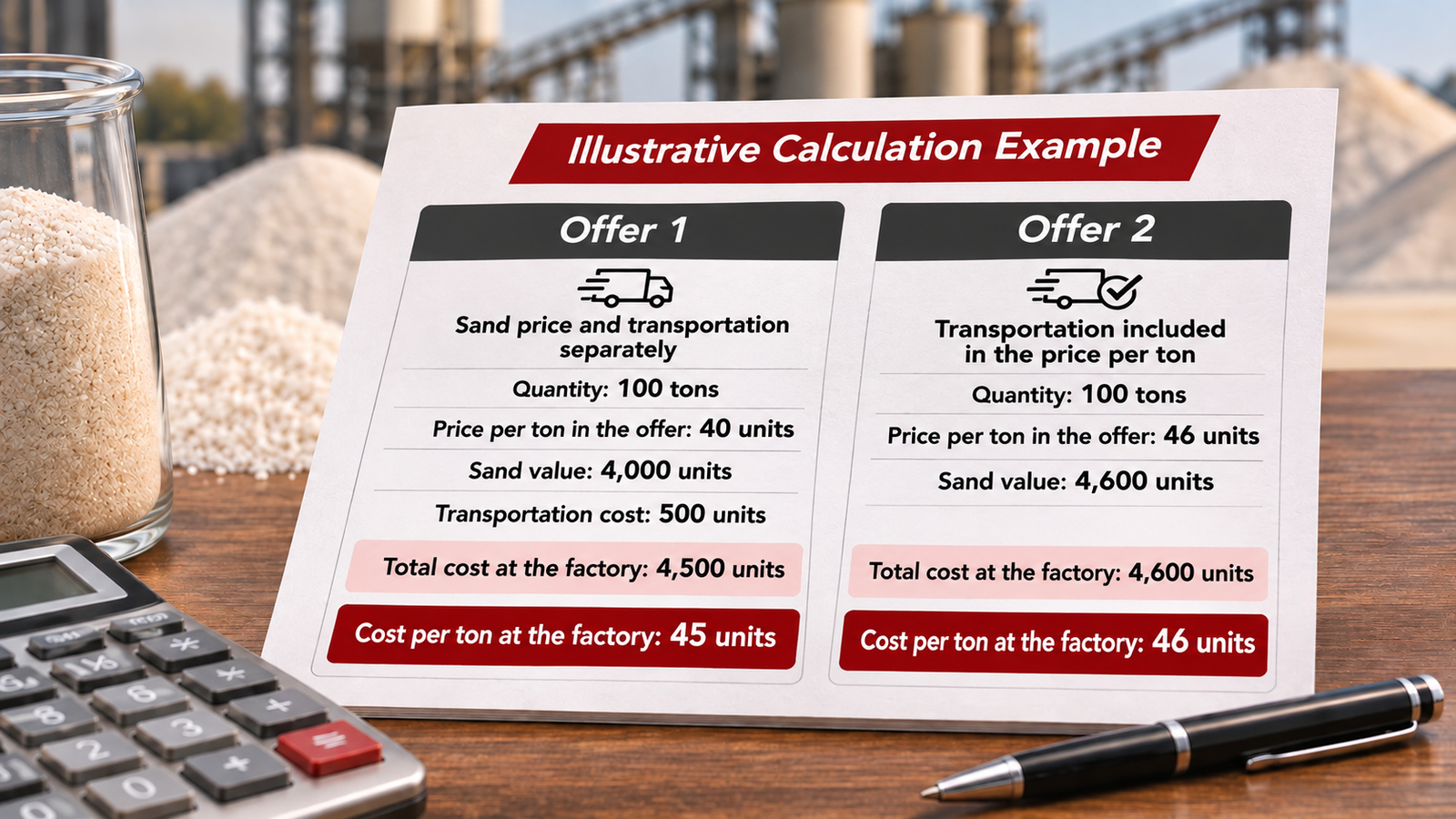
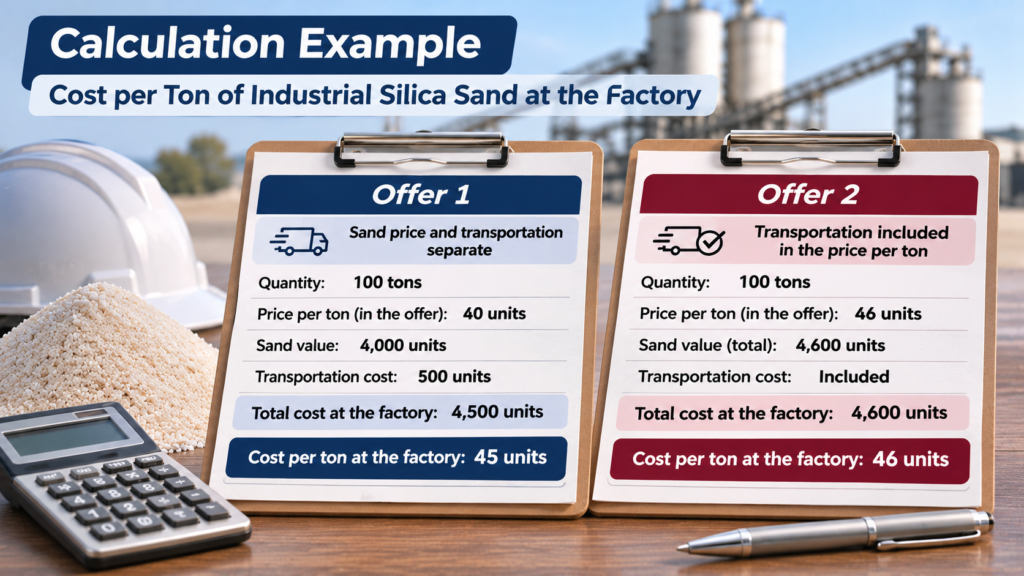
    Consider a factory that needs 100 metric tons of industrial silica sand.

    The purchasing department receives two quotations for material that meets the required technical specifications. Both quotations use the same currency and delivery destination.

    The following figures are hypothetical and expressed in fictional currency units. They do not represent actual market prices or quotations issued by Knooz Watad Mining.

    Supplier Quote A: Silica Sand Price and Transportation Quoted Separately

    • Required quantity: 100 metric tons.
    • Quoted silica sand price: 40 currency units per ton.
    • Total material cost: 4,000 currency units.
    • Transportation cost for the entire shipment to the factory gate: 500 currency units.
    • Total delivered cost: 4,500 currency units.
    • Delivered cost per ton: 45 currency units.

    Calculation:

    Material cost = 100 × 40 = 4,000 currency units.

    Total delivered cost = 4,000 + 500 = 4,500 currency units.

    Delivered cost per ton = 4,500 ÷ 100 = 45 currency units per ton.

    Supplier Quote B: Transportation Included in the Price per Ton

    • Required quantity: 100 metric tons.
    • Quoted silica sand price: 46 currency units per ton.
    • Transportation to the factory gate: Included.
    • Total delivered cost: 4,600 currency units.
    • Delivered cost per ton: 46 currency units.

    Calculation:

    Total delivered cost = 100 × 46 = 4,600 currency units.

    Delivered cost per ton = 4,600 ÷ 100 = 46 currency units per ton.

    In this example, transportation costs should not be added again to Supplier Quote B because they are already included in the quoted price per ton.

    4. Which Silica Sand Supplier Offers Better Value?

    In the example above, Supplier Quote A has a lower delivered cost by one currency unit per ton.

    For the entire 100-ton shipment, this represents a difference of 100 currency units.

    However, this conclusion is valid only if both silica sand products meet the required technical specifications, the quantities and weight bases are identical, the delivery points are the same, and all necessary costs have been included without overlooking additional charges.

    Before making the final purchasing decision, you should also review payment terms, delivery schedules, and contractual obligations.

    The lowest silica sand price does not necessarily represent the most suitable option for your factory’s operational requirements.

    If any quotation details remain unclear, send the supplier a specific question, such as:

    “Does your quoted price include transportation to our factory gate for the required 100 metric tons, or will additional charges apply?”

    This simple clarification can resolve uncertainty without requiring the supplier to prepare an entirely new quotation.

    5. When Are Two Silica Sand Quotations Not Ready for Comparison?

    Do not rely on a price comparison when important technical or commercial information remains unresolved.

    For example, Supplier Quote A may offer a lower delivered cost but fail to provide a technical analysis report confirming that the silica sand meets your required particle size distribution.

    In this situation, the price difference alone is not sufficient justification for selecting that supplier.

    Similarly, one quotation may include transportation without specifying whether unloading is also covered.

    If unloading costs are the buyer’s responsibility and affect the cost at the agreed comparison point, they must be identified before making a purchasing decision.

    The essential principle is straightforward: verify technical compliance first, then compare the actual delivered cost using consistent commercial terms.

    This approach allows procurement teams to evaluate industrial silica sand quotations more accurately and make purchasing decisions based on both product suitability and total cost.

    Request an Industrial Silica Sand Quote Based on Your Factory’s Requirements

    If you are comparing industrial silica sand suppliers, you can contact Knooz Watad Mining to request a quotation based on your factory’s specific requirements.

    Providing the required quantity, technical specifications, and delivery destination helps the supplier prepare a quotation that can be compared with other offers on a clear and consistent basis.

    Whether your factory requires silica sand for glass production, foundry applications, water filtration, or other industrial uses, a well-defined quotation request is an important step toward evaluating the available supply options.
    Request an industrial silica sand quote based on your factory’s specifications through the Knooz Watad Mining quotation request form.

  • How to Request a Quote for Industrial Silica Sand: What Suppliers Need to Know

    How to Request a Quote for Industrial Silica Sand: What Suppliers Need to Know

    To request a quote for industrial silica sand, prepare four key details: the intended application, the quantity required per shipment, the delivery destination, and any available technical specifications. If your production schedule depends on a specific delivery date, include your required arrival date as well.

    You can submit an inquiry even if your laboratory has not finalized the material specifications. The important thing is to clearly explain what you already know and which requirements are still being evaluated.

    How Should You Describe Your Silica Sand Application?

    Start by explaining what your factory manufactures and where silica sand is used in the production process.

    For example, if you are purchasing silica sand for glass manufacturing, specify whether it will be used to produce clear or colored glass containers.

    This distinction matters because Knooz Watad Mining offers two glass sand grades with different technical specifications, including maximum iron oxide (Fe₂O₃) content.

    Providing this information helps the supplier identify a potentially suitable grade while allowing your quality control team to compare its specifications against your production requirements.

    Silica Sand for Glass Manufacturing

    Silica Sand for Construction

    Silica Sand for Water Filtration

    Silica Sand for Foundry Applications

    Silica Sand for Concrete

    If your factory has approved raw material specifications, include the parameters that determine whether the material can be accepted, along with their measurement units.

    If you only have a laboratory analysis report from a previously tested sample, clarify that it is being provided as a reference for comparison.

    Remember that a measured result from a previous sample and the maximum or minimum acceptable value established by your factory are two different pieces of information.

    How to Read a Silica Sand Analysis Report

    How to Request a Quote for Industrial Silica Sand: What Suppliers Need to Know

    How to Specify Quantity, Delivery Location, and Schedule

    A request stating “We need 100 tons of silica sand” leaves several important questions unanswered.

    Is this quantity required for a single order or an entire month? Will it be delivered in one shipment or multiple batches?

    If your estimated demand is not yet confirmed, make that clear in your inquiry.

    Providing the quantity, delivery destination, and required arrival date helps the silica sand supplier understand exactly what needs to be quoted.

    Order Quantity and Supply Frequency

    Specify the total quantity of silica sand required and whether it represents a one-time purchase, monthly demand, or a recurring supply requirement.

    Whenever possible, indicate the number of shipments.

    For example: “We require approximately 100 metric tons of silica sand per month, delivered in two shipments.”

    This information helps the supplier understand the shipment size and delivery frequency rather than assuming the entire quantity will be delivered at once.

    Delivery Destination

    Clearly identify the city and exact delivery location.

    For example: “Our factory warehouse in Adra Industrial City, Rural Damascus, Syria.”

    Providing the destination allows the supplier to identify the requested delivery point and assess whether transportation to that location can be arranged.

    Required Delivery Date

    Specify when the silica sand must arrive at your facility, rather than simply stating when it should be dispatched.

    For example: “The first shipment must arrive during the first week of the month.”

    This distinction helps prevent confusion between the dispatch date and the required delivery date.

    Practical Example of a Silica Sand Supply Inquiry

    When a factory writes, “We need 100 tons of silica sand,” the supplier only knows the requested quantity.

    A more complete inquiry would explain that the silica sand is intended for colored glass container production and that the factory requires approximately 100 metric tons per month, delivered in two shipments to its warehouse in Adra Industrial City.

    With this information, the supplier can review the relevant silica sand grade and prepare a quotation based on a more clearly defined requirement.

    Technical compliance and delivery feasibility must still be confirmed by both parties before the purchase is finalized.

    What If You Do Not Have Final Technical Specifications?

    You can still request a silica sand quotation even if your factory has not finalized its technical requirements.

    Start by describing your finished product, the intended application of the silica sand, and the properties your technical team needs to evaluate.

    For example, if your factory is looking for an alternative to its current silica sand supplier, explain whether you need a similar particle size distribution or want to test a different grade.

    You may also provide the technical data sheet of your currently used material as a reference, while clarifying that your laboratory is still evaluating the requirements for a replacement.

    If your factory has not approved a specific silica purity level or particle size range, avoid providing estimated figures as though they were confirmed requirements.

    Instead, you could state:

    “We would like to review the available particle size distributions with our laboratory before selecting the appropriate silica sand grade.”

    This gives the supplier a useful starting point without requesting a quotation based on unverified technical parameters.

    What Information Is Required in the Knooz Watad Mining Quotation Form?

    The silica sand quotation request form on the Knooz Watad Mining website includes several essential fields that help the sales team understand your purchasing requirements and contact your company.

    The required fields shown in the form include your full name, company name, email address, phone or WhatsApp number with country code, final destination country, requested product, and estimated quantity.

    Delivery terms, additional details, and file attachments appear as optional fields.

    The form also allows you to upload a technical specification document as a PDF or image, with a maximum file size of 10 MB.

    How to Use the Additional Details Field

    Use the additional details section to provide information that helps the supplier prepare a more accurate silica sand quotation.

    Include the specific industrial application, the quantity required per shipment, the delivery city or facility location, and the requested arrival date.

    If your factory has special technical requirements, mention them or attach the relevant specification document.

    These details help the Knooz Watad Mining sales team determine which requirements can be quoted immediately and which may need further technical clarification.

    Ready to Request a Silica Sand Quotation?

    Whether you need silica sand for glass manufacturing or another industrial application, preparing a clear inquiry is the first step toward identifying a suitable product and discussing supply requirements.

    Share your application, estimated quantity, available technical specifications, and delivery requirements with Knooz Watad Mining.

    Our team can review your inquiry, assess the relevant product specifications, and discuss available supply options based on your factory’s needs.

    Request a Silica Sand Quote

  • Why Iron Content Defines Glass Quality

    Why Iron Content Defines Glass Quality

    Iron oxides (Fe₂O₃) are the first enemy of glass clarity. Above roughly 0.030%, they give clear glass an unwanted green tint that becomes obvious at the edges of a sheet.

    That is why global glassmakers enforce strict iron limits on silica sand. Knooz Watad supplies its clear-glass grade at no more than 0.030% Fe₂O₃, achieved through advanced magnetic separation and washing — which is what keeps colour consistent from shipment to shipment.