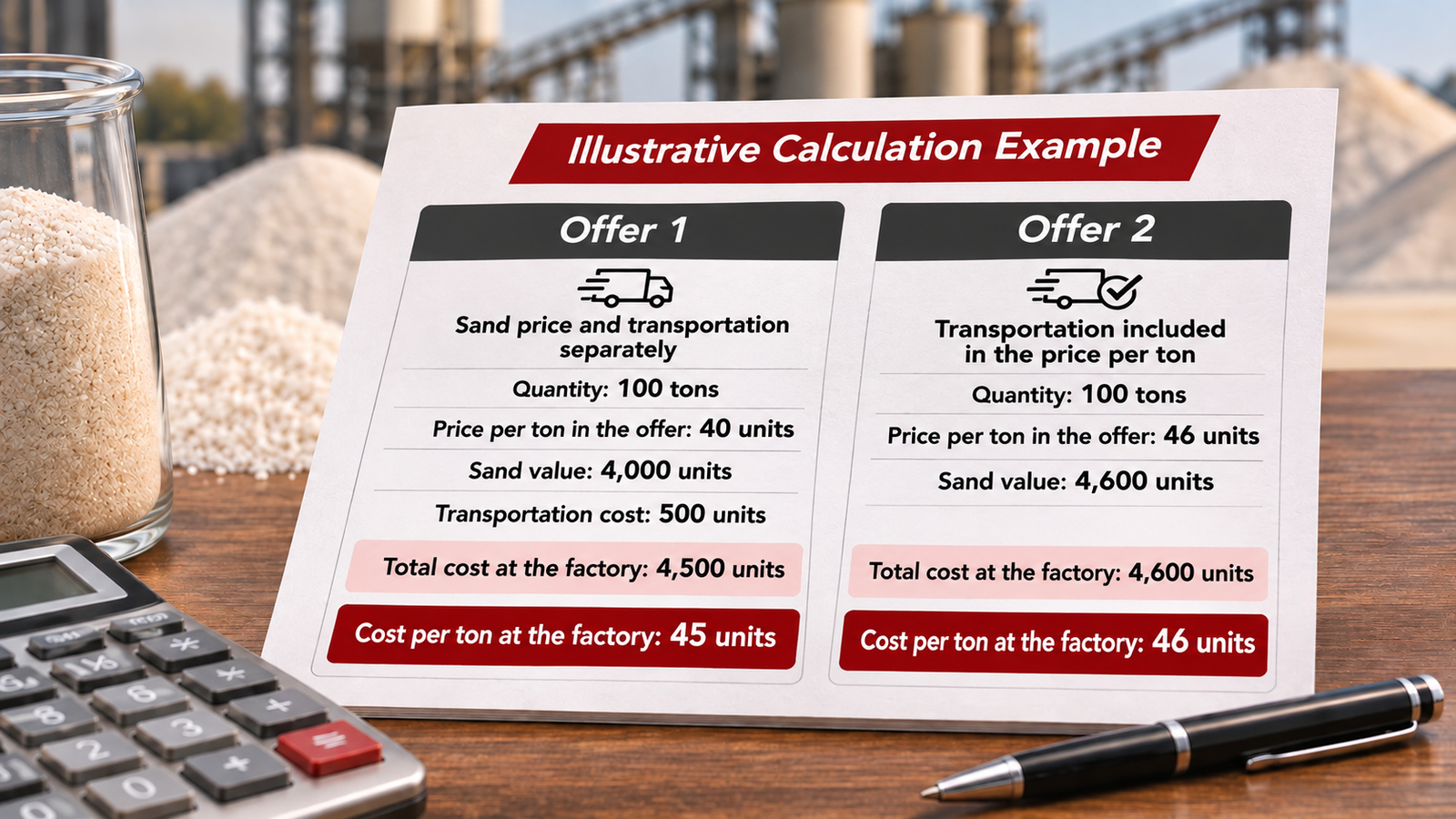
A purchasing manager receives two quotations for industrial silica sand. The first supplier quotes a price per ton for collection at the supplier’s facility, while the second includes delivery to the factory.
One quotation appears cheaper than the other. But can these prices be compared directly?
Not necessarily. The two quotations do not include the same costs and services. Before selecting the most suitable offer, you need to confirm that both silica sand products meet your technical specifications and calculate their costs using the same quantity, currency, and delivery point.
The quoted silica sand price per ton is the amount a supplier charges under the terms stated in their quotation. The delivered cost per ton is calculated by adding the cost of the silica sand and all necessary expenses to reach the agreed delivery point, then dividing the total by the quantity using the agreed weight basis.
Understanding this difference helps industrial buyers compare silica sand suppliers more accurately and avoid unexpected procurement costs.
1. Do Both Silica Sand Quotations Meet Your Technical Specifications?
Before comparing silica sand prices, confirm that both suppliers are offering material suitable for the same industrial application.
Two suppliers may quote different prices for silica sand, but variations in particle size distribution or impurity levels can make one product unsuitable for your production process, even if it is cheaper.
Review the technical information provided in each quotation, particularly the following:
- Particle size distribution: Does the grain size and its distribution fall within the range required by your production line?
- Chemical composition: Do the chemical components and relevant impurity limits meet your approved specifications?
- Sand condition and processing: Does the material meet your application’s requirements for washing, drying, or other processing methods, where applicable?
- Technical documentation: Does the supplier provide a laboratory analysis report or technical data sheet that allows you to verify compliance?
The importance of these characteristics varies depending on the application, whether the silica sand is intended for glass manufacturing, foundry casting, water filtration, or construction materials.
Therefore, a single silica purity percentage should not be used as a universal quality standard across all industries.
If one supplier has not provided sufficient technical information, do not automatically classify the material as compliant or non-compliant.
Request the missing specifications and postpone the purchasing decision until the material’s suitability has been verified.
To better understand how to evaluate technical data, read our guide on silica sand specifications and how to interpret a laboratory analysis report.
2. How to Compare Silica Sand Prices on the Same Basis
Once you have confirmed technical compliance, the next step is to review the commercial terms.
Comparing the quoted silica sand price per ton alone is not enough. One quotation may include transportation, packaging, or handling costs that are excluded from the other.
To make a fair comparison between silica sand suppliers, standardize the following factors:
- Quantity: Compare the cost of the same required quantity and verify the weight basis used in each quotation.
- Currency: Convert both quotations into the same currency and establish a reference exchange rate if different currencies are used.
- Packaging: Confirm whether the quoted price includes the required packaging or whether additional charges apply.
- Delivery point: Use the same destination for both quotations, such as the factory gate or another agreed receiving location.
- Transportation and handling: Check which loading, freight, and unloading services are included. Add only the necessary costs that are not already covered in the quotation.
If the cost of an essential item is unknown, do not assume it is zero.
Instead, request clarification or an additional cost estimate before finalizing your comparison.
3. Practical Example: How to Calculate the Delivered Cost of Silica Sand per Ton
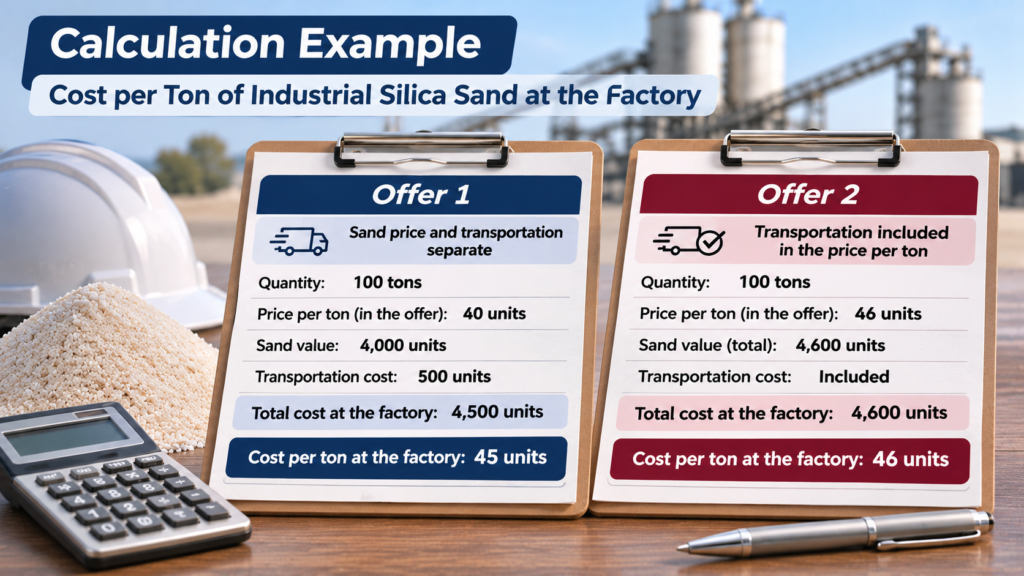
Consider a factory that needs 100 metric tons of industrial silica sand.
The purchasing department receives two quotations for material that meets the required technical specifications. Both quotations use the same currency and delivery destination.
The following figures are hypothetical and expressed in fictional currency units. They do not represent actual market prices or quotations issued by Knooz Watad Mining.
Supplier Quote A: Silica Sand Price and Transportation Quoted Separately
- Required quantity: 100 metric tons.
- Quoted silica sand price: 40 currency units per ton.
- Total material cost: 4,000 currency units.
- Transportation cost for the entire shipment to the factory gate: 500 currency units.
- Total delivered cost: 4,500 currency units.
- Delivered cost per ton: 45 currency units.
Calculation:
Material cost = 100 × 40 = 4,000 currency units.
Total delivered cost = 4,000 + 500 = 4,500 currency units.
Delivered cost per ton = 4,500 ÷ 100 = 45 currency units per ton.
Supplier Quote B: Transportation Included in the Price per Ton
- Required quantity: 100 metric tons.
- Quoted silica sand price: 46 currency units per ton.
- Transportation to the factory gate: Included.
- Total delivered cost: 4,600 currency units.
- Delivered cost per ton: 46 currency units.
Calculation:
Total delivered cost = 100 × 46 = 4,600 currency units.
Delivered cost per ton = 4,600 ÷ 100 = 46 currency units per ton.
In this example, transportation costs should not be added again to Supplier Quote B because they are already included in the quoted price per ton.
4. Which Silica Sand Supplier Offers Better Value?
In the example above, Supplier Quote A has a lower delivered cost by one currency unit per ton.
For the entire 100-ton shipment, this represents a difference of 100 currency units.
However, this conclusion is valid only if both silica sand products meet the required technical specifications, the quantities and weight bases are identical, the delivery points are the same, and all necessary costs have been included without overlooking additional charges.
Before making the final purchasing decision, you should also review payment terms, delivery schedules, and contractual obligations.
The lowest silica sand price does not necessarily represent the most suitable option for your factory’s operational requirements.
If any quotation details remain unclear, send the supplier a specific question, such as:
“Does your quoted price include transportation to our factory gate for the required 100 metric tons, or will additional charges apply?”
This simple clarification can resolve uncertainty without requiring the supplier to prepare an entirely new quotation.
5. When Are Two Silica Sand Quotations Not Ready for Comparison?
Do not rely on a price comparison when important technical or commercial information remains unresolved.
For example, Supplier Quote A may offer a lower delivered cost but fail to provide a technical analysis report confirming that the silica sand meets your required particle size distribution.
In this situation, the price difference alone is not sufficient justification for selecting that supplier.
Similarly, one quotation may include transportation without specifying whether unloading is also covered.
If unloading costs are the buyer’s responsibility and affect the cost at the agreed comparison point, they must be identified before making a purchasing decision.
The essential principle is straightforward: verify technical compliance first, then compare the actual delivered cost using consistent commercial terms.
This approach allows procurement teams to evaluate industrial silica sand quotations more accurately and make purchasing decisions based on both product suitability and total cost.
Request an Industrial Silica Sand Quote Based on Your Factory’s Requirements
If you are comparing industrial silica sand suppliers, you can contact Knooz Watad Mining to request a quotation based on your factory’s specific requirements.
Providing the required quantity, technical specifications, and delivery destination helps the supplier prepare a quotation that can be compared with other offers on a clear and consistent basis.
Whether your factory requires silica sand for glass production, foundry applications, water filtration, or other industrial uses, a well-defined quotation request is an important step toward evaluating the available supply options.
Leave a Reply